Book Appointment Now

Best Basketball Strategies for Team Success

Basketball is more than just a game; it’s a blend of strategy, skill, and teamwork. Recent studies show that offensive strategies greatly affect game outcomes. For example, teams that focus on outside shooting can boost their win probability significantly. This highlights the importance of choosing effective basketball strategies. By understanding and applying the right techniques, you can elevate your game and help your team succeed.
Key Takeaways
Implement offensive strategies like fast breaks to create quick scoring chances and catch opponents off guard.
Utilize the pick and roll to generate high-percentage shots and exploit defensive weaknesses.
Focus on teamwork by building chemistry and promoting open communication among players for better performance.
Practice key plays regularly in shorter sessions to enhance skill mastery and execution during games.
Adapt your strategies quickly during games to respond effectively to opponents and improve your chances of winning.
Offensive Strategies

Basketball offensive strategies play a crucial role in enhancing your team’s scoring potential. By understanding and implementing these strategies, you can create more scoring opportunities and improve your overall game performance. Here are three key offensive strategies to consider:
Fast Break
The fast break is one of the most exciting and effective offensive strategies in basketball. It allows your team to transition quickly from defense to offense, often catching the opposing team off guard. Here are some key points about the fast break:
The fast break strategy is defined as the fastest and most efficient transition from defense to offense.
Successful fast breaks increase scoring opportunities by outnumbering the defense and preventing it from organizing effectively.
In elite games, the success rate of fast breaks is 63.5%, while in sub-elite games, it is 59.7%.
To execute a successful fast break, focus on these factors:
Push the pace but recognize neutral situations. This helps maintain the flow of the offense.
Recognize a numerical advantage, such as 2-on-1 or 3-on-2 situations. Effective passing and driving strategies can capitalize on these advantages.
Develop elite running habits. Quick reactions and efficient movements are essential for creating and exploiting numerical advantages.
Pick and Roll
The pick and roll is another powerful offensive strategy that can generate high-percentage shots. This play involves a player setting a screen for the ball handler, who then has the option to either shoot or pass to the rolling player. Here’s why the pick and roll is effective:
According to recent analytics, 51% of actions following a screen result in a shot attempt.
Coaches emphasize that the pick-and-roll creates opportunities for open shots, contributing to its effectiveness in generating high-percentage shots.
When executing the pick and roll, be aware of common defensive adjustments, such as trap coverage and under coverage. Understanding these adjustments can help you exploit the defense effectively.
Isolation Plays
Isolation plays focus on creating one-on-one scoring opportunities. This strategy allows your best offensive players to take advantage of mismatches against defenders. Here’s how isolation plays impact your team’s offensive efficiency:
Metric | Isolation Plays | Off-Screen Plays |
|---|---|---|
Points Per Possession | High | Moderate |
Effective FG % | High | Moderate |
Isolation plays can lead to high scoring efficiency, especially when executed by skilled players. However, teamwork remains essential. Successful teams often demonstrate a higher frequency of offensive strategies that rely on collaboration, such as cuts and low-post offense.
Defensive Strategies for Team Success
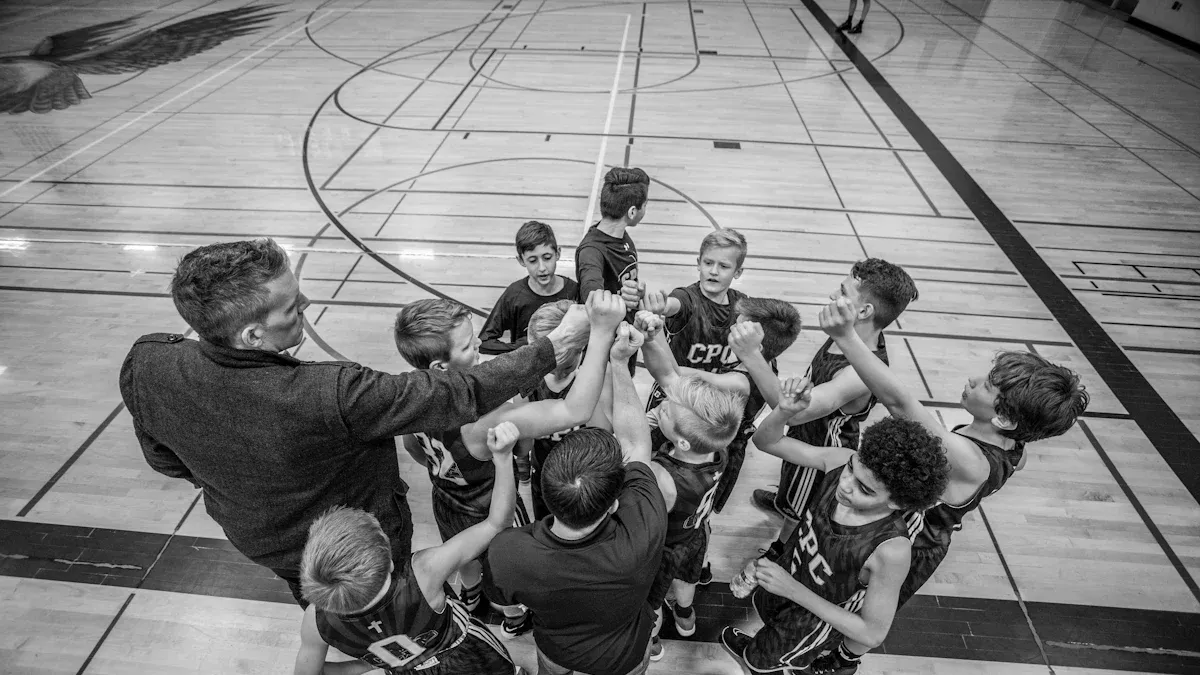
Effective defensive strategies are essential for achieving team success in basketball. A strong defense can limit the opponent’s scoring opportunities and create turnovers. Here are three key defensive strategies to consider:
Man-to-Man Defense
In man-to-man defense, each player is responsible for guarding a specific opponent. This strategy allows you to match players based on their position, ability, or size. Here are some key principles to implement man-to-man defense effectively:
Rule Number | Key Principle | Description |
|---|---|---|
1 | No Middle Penetration | Prevent opponents from entering the middle of the lane to maintain defensive integrity. |
2 | No Ball Reversals | Avoid allowing the ball to be reversed to prevent defensive gaps and scoring opportunities. |
3 | No Full Help From One Passes Away | Players should provide limited help to avoid leaving their assigned offensive player open. |
4 | No Front Cuts | Defenders must stay between their opponent and the ball to prevent easy cuts to the basket. |
5 | Move When the Ball Moves | All defenders should adjust their positions in response to the ball’s movement to maintain coverage. |
By following these principles, you can enhance your team’s defensive effectiveness. Championship-winning teams often rely on man-to-man defense to disrupt their opponents’ rhythm.
Zone Defense
Zone defense involves players guarding specific areas rather than individual opponents. This strategy can confuse the offense and limit high-percentage shots. Here are some popular types of zone defenses:
Zone Defense Type | Description |
|---|---|
2-3 Zone Defense | Players guard areas in a 2-3 formation, effective for protecting the paint and rebounding. |
1-3-1 Zone Defense | Creates turnovers and confuses opponents with a unique alignment. |
Matchup Zone Defense | Combines elements of man-to-man and zone, allowing for flexible defensive strategies. |
Buzz ½ Court Trapping Zone | A trapping defense that forces turnovers and speeds up the tempo of the game. |
Zone defenses can significantly affect opponent shooting percentages. Research shows that increasing the percentage of shots taken less than three feet from the rim decreases the opponent’s three-point shooting percentage. This highlights the importance of adapting your defense to counter different offensive systems.
Press Defense
Press defense applies pressure on the opposing team as they bring the ball up the court. This strategy aims to create turnovers and disrupt the opponent’s offensive flow. Here are some key points about press defense:
Full-Court Press: This involves applying pressure across the entire court. It can force hurried decisions and mistakes from the opposing team.
Half-Court Trap: This strategy traps the ball handler in the half-court area, making it difficult for them to pass or dribble effectively.
Situational Adaptation: You can adjust your press defense based on the game situation. For example, if your team is trailing, applying a press can create quick scoring opportunities.
By understanding and implementing these defensive strategies, you can enhance your team’s overall performance and increase your chances of success on the court.
Key Plays for Success
Understanding key plays can significantly enhance your team’s performance on the court. Here are three essential plays that you should master:
Triangle Offense
The Triangle Offense is a dynamic system that promotes ball movement and scoring opportunities. Here’s how it works:
A guard passes to the wing and cuts to the strong-side corner.
A triangle forms with a post player on the strong-side block, the strong-side corner, and the extended strong-side wing.
The initial option is to pass to the strong-side post player, who can either score or pass to perimeter players, creating multiple scoring avenues.
This offense prioritizes player movement over set plays. It operates as a ‘mirror offense,’ ensuring similar actions occur on both sides of the court. This system encourages interchangeability and off-the-ball movement, leading to diverse scoring options.
Give and Go
The Give and Go play is a simple yet effective strategy that enhances offensive efficiency. Here’s why you should implement it:
It enhances player movement, crucial for creating space on the court.
It promotes effective spacing, allowing players to position themselves optimally for scoring opportunities.
Quick decision-making becomes essential, as players must react to their teammates’ and defenders’ movements.
By passing and cutting, players create open shots and driving lanes, leading to higher scoring chances.
This play can be a game-changer when executed correctly.
Flex Offense
The Flex Offense is structured to promote continuous movement, cutting, and screening. This leads to high-percentage scoring opportunities. It exhausts defenses and can be tailored to your players’ strengths. The Flex Offense allows for quick transitions and aggressive attacks, preventing the defense from organizing effectively.
To master these plays, regular practice is vital. Research shows that frequent, shorter training sessions yield better results than infrequent, longer ones. Consistent practice leads to better skill adaptation and mastery.
Evidence Type | Description |
|---|---|
Training Frequency | Frequent, shorter training sessions are more effective than infrequent, longer ones. |
Skill Development | Scientific studies indicate that consistent practice leads to better skill adaptation and mastery. |
By focusing on these key plays and committing to practice, you can elevate your team’s performance and increase your chances of success on the court.
Importance of Teamwork
Teamwork is vital for success in basketball. When players work together, they enhance their performance and create a winning environment. Here are two key aspects of teamwork that you should focus on: building chemistry and effective communication.
Building Chemistry
Building chemistry among teammates is essential. Strong relationships lead to better performance on the court. Here are some effective methods to foster team chemistry:
Define Core Team Values: Establish loyalty, character, accountability, and commitment. These values help create unity and improve performance.
Promote Open Communication: Encourage players to share thoughts and feedback. Regular meetings can help everyone stay on the same page.
Engage in Shared Experiences: Participate in group drills that require teamwork. This enhances player connections and fosters a cohesive environment.
Implement Collaborative Drills: Use exercises that necessitate mutual dependence. This builds chemistry and teamwork among players.
Monitor and Reinforce Dynamics: Regularly assess team interactions. Recognize positive behaviors to maintain a healthy team culture.
Teams with a history of shared successes tend to perform better. Research shows that including past teamwork in performance models can improve the accuracy of predicting game outcomes by 2 to 7 percentage points. This highlights the significance of building strong team chemistry.
Effective Communication
Effective communication is crucial for successful teamwork. It allows players to call out plays and identify defensive assignments. This clarity is vital for executing strategies effectively. On defense, teams must communicate to ensure everyone understands their roles. This helps avoid confusion and potential scoring opportunities for the opponent.
Good communication fosters a closer-knit team. Players learn to articulate their needs and thoughts. They also develop conflict resolution skills, which are important during competition. By navigating disagreements, players find common ground and move forward productively.
In basketball, success hinges on effective strategies and teamwork. You should focus on building systems rather than relying solely on star players. A strong team culture acts as glue, enhancing performance. Adaptability is crucial; quick adjustments can lead to victories. Remember these key takeaways:
Build systems, not just superstars.
Shape culture as glue.
Invest wisely without overspending.
Adapt by adjusting fast.
Lead beyond the scoreboard.
Incorporating basketball practice drills and offensive skill drills into your training can further enhance your team’s performance. Embrace these strategies, and watch your team thrive on the court!
