Book Appointment Now

How to Speed Up Your Reflexes for Boxing Success
In boxing, sharp reflexes can mean the difference between victory and defeat. When you speed up reflexes, you respond faster to your opponent’s moves, making it easier to dodge punches and land your own. You can enhance your reflexes through targeted training methods like using reaction balls or practicing with a double-end bag. These techniques not only improve your reaction time but also boost your confidence in the ring. So, are you ready to take your training to the next level? Let’s get started!
Key Takeaways
Incorporate light training into your routine to enhance muscle memory and reaction time.
Practice catching and throwing drills, like using a reaction ball, to improve hand-eye coordination.
Engage in slow sparring to focus on movements and build muscle memory without pressure.
Combine physical training with mental conditioning techniques to sharpen your reflexes.
Create a structured training schedule and track your progress to stay motivated and see improvements.
Drills to Speed Up Reflexes
Light Training
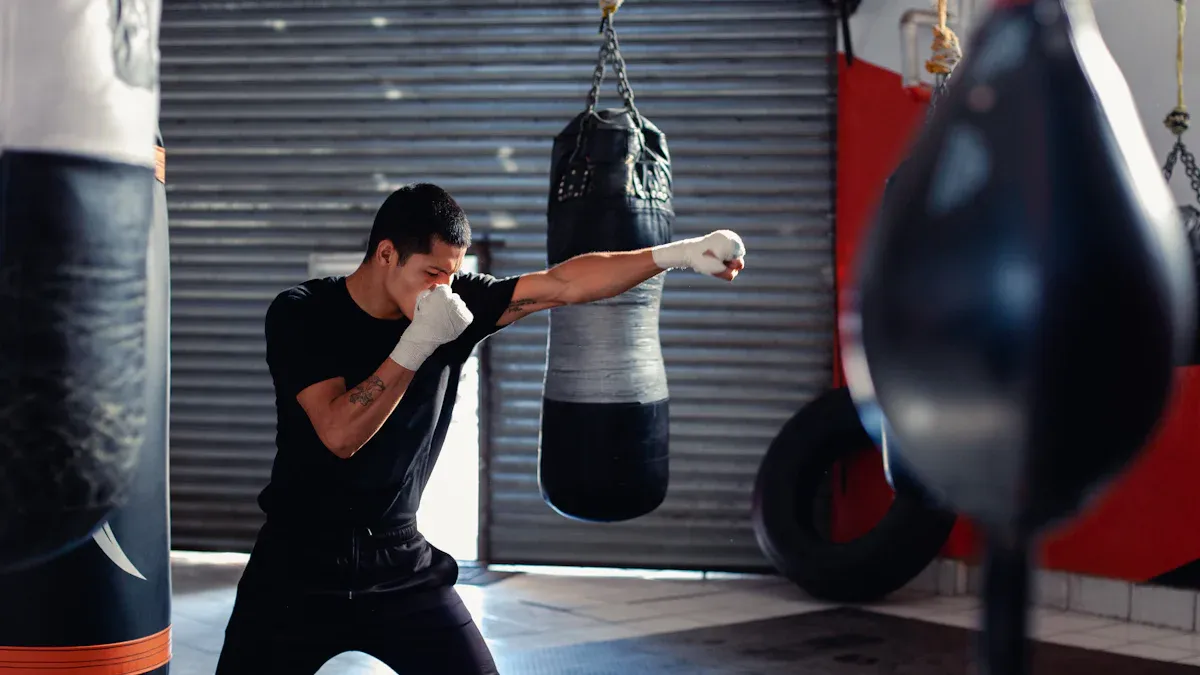
Light training is a fantastic way to speed up reflexes. It helps you develop quick responses without the pressure of intense sparring. You can start with simple exercises like shadow boxing. This allows you to focus on your movements and improve your muscle memory. When you add light weights to your hands, you enhance your arm speed. This combination boosts your overall reaction time.
Studies show that light training significantly improves reaction time in athletes, including boxers. By using perceptual cues during training, you can sharpen your ability to respond quickly. This training leads to better accuracy and faster responses in the ring. So, make sure to incorporate light training into your routine.
Catching and Throwing Drills
Catching and throwing drills are another excellent way to improve your reflexes. These drills enhance your hand-eye coordination, which is crucial for boxing. One effective drill involves using a reaction ball. This ball bounces unpredictably, forcing you to react quickly. As you catch it, you train your brain and body to respond faster.
Another great drill is the tennis ball drill. You throw a tennis ball against a wall and catch it as it rebounds. This simple exercise helps develop quick reflexes and coordination. Overall, these drills improve your reaction time, agility, and hand-eye coordination, all essential for boxing success.
Here’s a quick overview of some top drills recommended by professional boxing coaches to enhance reflex speed:
Shadow Boxing with Hand Weights: Enhances arm speed and muscle memory.
Speed Bag Workout: Improves hand speed and coordination.
Heavy Bag Interval Training: Increases speed under fatigue and cardiovascular fitness.
Resistance Band Punches: Activates fast-twitch muscle fibers for explosive strength.
Plyometric Push-Ups: Boosts upper body power and core stability.
Incorporating these drills into your training will help you improve your reflexes and become a more effective boxer. Remember, consistency is key. The more you practice, the better your reflexes will become!
Techniques to Train Like a Fighter
Slow Sparring
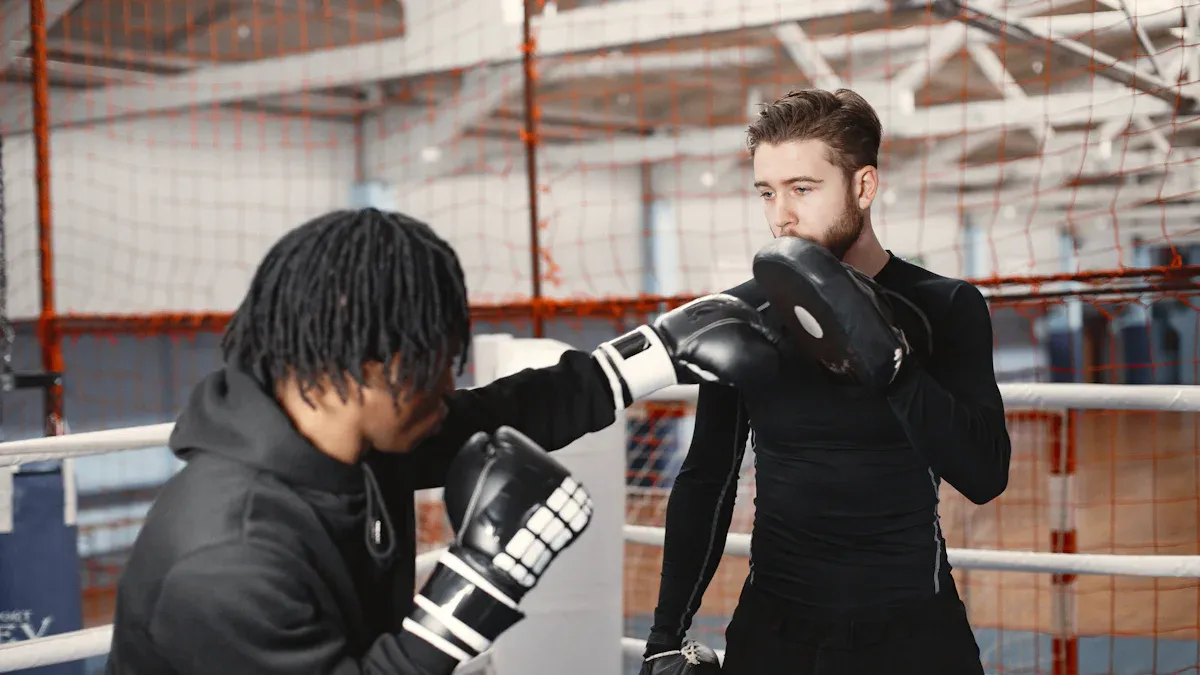
Slow sparring is a fantastic technique to enhance your reflexes. Unlike traditional sparring, this method allows you to focus on your movements and reactions without the pressure of full-speed exchanges. You can practice your footwork, head movement, and defensive maneuvers at a slower pace. This gives you the chance to think critically about your actions and improve your timing.
During slow sparring, pay attention to your opponent’s movements. This practice helps you anticipate their actions, sharpening your reflexes. You’ll find that as you become more comfortable with the pace, your ability to react quickly in real fights will improve. Remember, the goal is to build muscle memory and confidence.
Tip: Pair slow sparring with mental conditioning exercises. Visualize your movements and responses during practice. This combination will help you react more instinctively when it counts.
Deadlifts for Reflex Improvement
Deadlifts are not just for building strength; they can also significantly improve your reflexes. This compound exercise engages multiple muscle groups, enhancing your overall power and explosiveness. When you perform deadlifts, you activate fast-twitch muscle fibers, which are crucial for quick movements in the ring.
Research shows that deadlifts can enhance your performance in explosive movements. Here’s a quick look at some findings from studies on deadlifts:
Finding | Description |
|---|---|
Maximal Isometric Force | Performing deadlifts at a high barbell position (75% LLH) produces higher maximal isometric force compared to a lower position (25% LLH). |
Jump Performance | The high barbell position positively affects squat jump performance, indicating a link between deadlift performance and explosive movement capabilities. |
PAPE Mechanism | The results support the post-activation performance enhancement (PAPE) phenomenon, suggesting that conditioning activities like deadlifts can improve power output in subsequent explosive movements. |
Incorporating deadlifts into your training routine will not only build strength but also enhance your reflexes. As you lift heavier weights, your body learns to respond faster to the demands of the sport.
Mental Conditioning
Don’t forget about mental conditioning! It plays a vital role in your reflex training. A calm and focused mind enhances your ability to react swiftly and accurately. Here are some effective mental conditioning techniques used by elite fighters:
Daily visualization sessions: Imagine specific fight scenarios to mentally prime your responses.
Structured meditation periods: Regular quiet reflection helps create mental clarity and concentration.
Strategic games: Playing chess or puzzles sharpens your pattern recognition skills.
Pressure simulation drills: Coaches add distractions to help you learn to stay focused under stress.
Progressive muscle relaxation: This technique aids in mental restoration between training sessions.
By combining physical training with mental exercises, you’ll develop a well-rounded approach to improving your reflexes.
Consistency in Training
Setting a Training Schedule
Creating a structured training schedule is essential for improving your reflexes. It helps you stay organized and ensures you dedicate enough time to practice. Aim for a mix of drills and exercises that target different aspects of your reflexes. Here are some key components to include in your schedule:
Shoulder Touch Drill: This enhances your defensive reactions and distance management.
Cobra Bag: Use this to train your recognition of punching angles and reflexive movements.
Sparring: Controlled sparring develops your fighting instincts in a safe environment.
Free Flow Mitt Work: This encourages adaptability in your striking and footwork.
Think Fast: This emphasizes the importance of quick reflexes in boxing.
For optimal results, consider the following training frequencies based on your experience level:
Training Level | Frequency (Days/Week) | Rest Intervals (Seconds) | Recovery Between Sessions (Days) |
|---|---|---|---|
Novices | 2 to 3 | 5-10 to 2-4 minutes | At least 2, preferably 4 |
Advanced | 4 to 5 | 5-10 to 2-4 minutes | At least 2, preferably 4 |
Tracking Your Progress
Tracking your progress is crucial for seeing improvements in your reflexes. It keeps you motivated and helps you identify areas that need more focus. Here are some effective methods to monitor your development:
Shadowboxing with Visualization: Imagine an opponent while you practice to enhance your natural reactions.
Reaction Ball Drills: Use a reaction ball to improve your hand-eye coordination and reaction speed.
Focus Mitt Drills with Random Combos: Practice with a partner using random combinations to simulate real fight conditions.
Controlled Sparring: Engage in light sparring to focus on technique without the risk of heavy blows.
Slip Rope Training: This helps enhance your head movement and defensive reflexes.
Speed Bag Work: Working on a speed bag improves your timing, rhythm, and hand-eye coordination.
By consistently following your training schedule and tracking your progress, you’ll see significant improvements in your reflexes. Remember, the key to success in boxing lies in your dedication and commitment to training.
Improving your reflexes is crucial for boxing success. By incorporating drills like shadowboxing and partner exercises, you can sharpen your skills and enhance your reaction time. Remember, consistency is key!
Here are some important points to keep in mind:
Practice regularly: The more you train, the more instinctive your movements become.
Engage in partner drills: These help you react quickly to an opponent’s actions.
Focus on head movement: This improves your defense and sets up counterattacks.
So, get out there and start implementing these techniques. Your hard work will pay off in the ring!
FAQ
What is the best way to train for faster reflexes in boxing?
The best way to train is through consistent drills like shadow boxing, catching drills, and slow sparring. These exercises help you think fast and improve your reaction time.
How often should I practice reflex training?
Aim for at least 3 to 5 days a week. Consistency is key to developing your fighting instincts and enhancing your overall performance in boxing.
Can mental conditioning improve my reflexes?
Absolutely! Mental conditioning techniques, like visualization and meditation, help you stay focused and react quickly during fights. A calm mind enhances your reflexes significantly.
Do I need special equipment for reflex training?
While some drills require equipment like reaction balls or speed bags, many effective exercises need no equipment at all. You can practice shadow boxing or partner drills anywhere.
How long will it take to see improvements in my reflexes?
With consistent training, you can start noticing improvements in a few weeks. Stay dedicated to your boxing and kickboxing training, and you’ll see results!
