Book Appointment Now

Basketball Training Tips to Boost Your Vertical Jump
In basketball, your vertical jump can make a significant difference in your performance. A higher jump allows you to reach the basket more easily, block shots, and grab rebounds. Recent studies show a moderate negative correlation between static leg strength and vertical jump power, highlighting the need for targeted basketball training tips. To excel as a basketball player, focus on vertical jump training. Improved jumping ability can elevate your game and give you a competitive edge on the court.
Key Takeaways
Understand the mechanics of jumping. Focus on the impulse-momentum relationship to generate more force for higher jumps.
Incorporate strength training, plyometrics, and flexibility workouts into your routine. These exercises build the foundation for explosive power and improve jump height.
Master proper jump techniques. Pay attention to foot placement and arm movement to enhance your jumping ability and reduce injury risk.
Fuel your body with the right nutrition. Prioritize carbohydrates and protein to support energy and muscle recovery, and stay hydrated for optimal performance.
Track your progress consistently. Monitoring your training helps you stay motivated and make necessary adjustments to improve your vertical jump.
Jump Mechanics

Science of Jumping
Jumping is a complex movement that relies on several biomechanical principles. Understanding these principles can help you improve your vertical jump. Here are some key concepts:
Impulse-Momentum Relationship: This principle states that the impulse (force multiplied by time) leads to changes in momentum. You need to generate enough force over time to achieve a higher jump.
Work, Power, and Energy: Work is defined as force multiplied by distance. Power is the rate at which you do work. Both are essential for explosive movements like jumping.
Newton’s Laws of Motion: These laws explain how forces create motion. The second law (F=ma) emphasizes that you need greater force to accelerate heavier masses. This means that stronger muscles can help you jump higher.
Key Muscle Groups
Several muscle groups play a crucial role in generating power for your vertical jump. Here’s a breakdown of the primary muscles involved:
Muscle Group | Contribution to Jump Height | Role in Jumping |
|---|---|---|
Gluteus maximus | ~40% | Primary driver of hip extension |
Quadriceps | 25-30% | Responsible for knee extension |
Hamstrings | Assists with hip extension | Stabilizes the knee during countermovement |
Calves | 15-20% | Handles plantarflexion of the ankle |
Core muscles | N/A | Transfers force from lower body through trunk |
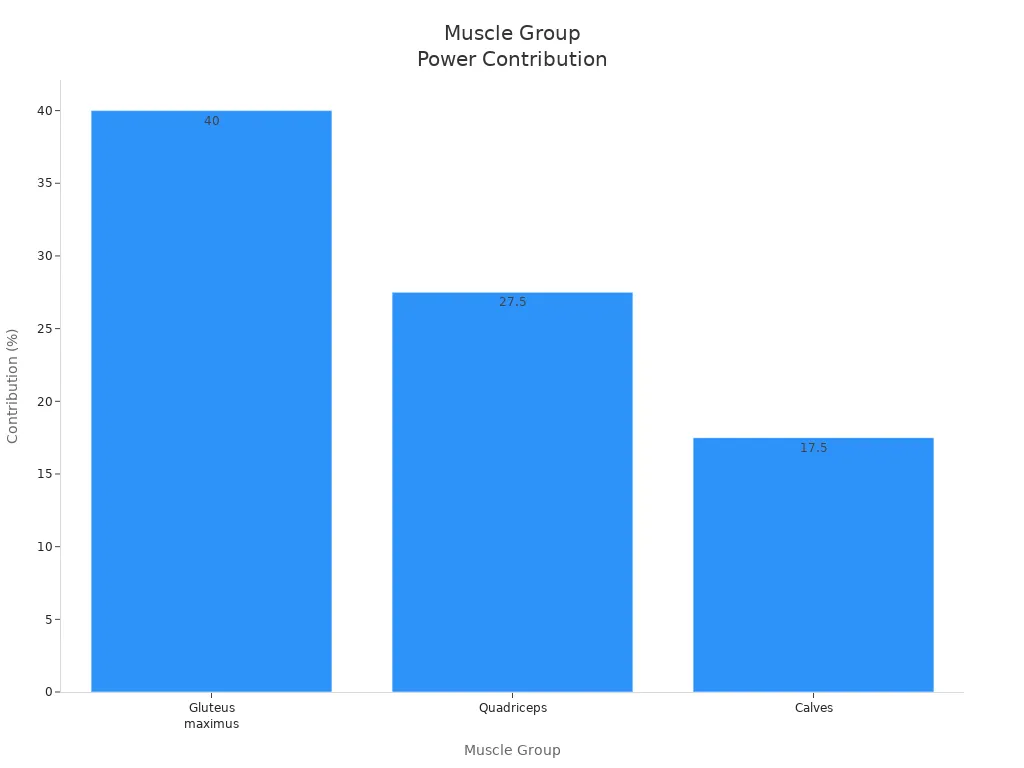
To maximize your vertical jump, focus on strengthening these muscle groups. Many players overlook the glutes, which are crucial for explosive power. Neglecting any of these muscles can hinder your performance.
By understanding the science behind jumping and the key muscle groups involved, you can tailor your training to improve your vertical jump effectively.
Key Exercises for Jump
To enhance your vertical jump, you must incorporate a variety of exercises into your training routine. This section covers three essential types of workouts: strength training, plyometrics, and flexibility workouts.
Strength Training
Strength training builds the foundation for explosive power. Focus on exercises that target the key muscle groups involved in jumping. Here are some effective strength training exercises:
Squats: Squats strengthen your quadriceps, hamstrings, and glutes. Aim for 3 sets of 8-12 repetitions.
Deadlifts: This exercise targets your posterior chain, including the glutes and hamstrings. Perform 3 sets of 6-10 repetitions.
Lunges: Lunges improve balance and strength in your legs. Try 3 sets of 10-12 repetitions on each leg.
Research indicates that one week of lower body strength training does not lead to significant improvements in vertical jump height. A longer duration of training is necessary to observe meaningful changes in vertical jump performance. Therefore, commit to a consistent strength training program over several weeks to see results.
Plyometrics
Plyometric exercises are crucial for developing explosive power. These workouts focus on quick, powerful movements that enhance your jumping ability. Here are some effective plyometric drills:
Trap Bar Jumps: These jumps bridge strength and explosiveness, making them ideal for athletes with a solid strength base.
Rebound Box Jumps: This drill develops reactive strength and elastic power, which are crucial for sports movements.
Depth Drop to Underhand Med Ball Vertical Toss: This exercise trains force absorption and explosive upward movement.
Band Accelerated Squat Jumps: These jumps enhance overspeed intent in vertical jump training.
Bulgarian Split Squat Jumps: This drill builds single-leg power and stability, addressing any asymmetries.
Much research has focused on the development of vertical jump performance. Coaches and researchers agree that plyometric training is a preferred method for improving vertical jump ability and leg muscle power. To maximize your gains, perform depth jumps 1-2 times a week, with a total of 20-40 contacts per session. Recovery is crucial, as full recovery from these intense exercises may take 4-6 days.
Flexibility Workouts
Flexibility plays a vital role in improving your vertical jump mechanics. Incorporate flexibility workouts into your training routine to enhance your performance. Here are some effective strategies:
Dynamic Stretching: Perform dynamic stretches before your workouts to maintain muscle performance. Studies show that dynamic stretching routines do not significantly decrease jump height.
Static Stretching: Long durations of static stretching (30 seconds) can increase flexibility without impairing jumping performance. This can coexist with improved jump mechanics.
Evidence Type | Findings | Implications |
|---|---|---|
Flexibility Training | Long durations of static stretching increased flexibility without impairing jumping performance. | Flexibility training can enhance counter-movement jump (CMJ) performance. |
Neural Adaptations | Decrease in Hoffmann reflex and tendon reflex after flexibility training. | Neural adaptations may contribute to better performance outcomes in elite athletes. |
By integrating strength training, plyometrics, and flexibility workouts into your routine, you can significantly improve your vertical jump. Stay committed to your training, and track your progress to see the results.
Proper Jump Technique
Foot Placement
Foot placement is crucial for maximizing your vertical jump. Proper positioning can enhance your jumping ability and reduce the risk of injury. Here are some key points to consider:
Initial Contact: Aim to land on the forefoot rather than flat-footed or on your hindfoot. Research shows that athletes who contact the ground with their forefoot have a lower risk of ACL injuries. This highlights the importance of foot placement in both jump height and injury prevention.
Knee Alignment: Ensure your knees track over your toes during takeoff. Incorrect foot placement can lead to knee valgus, increasing the risk of injury. A study indicates that athletes with knee valgus during jumps are more likely to sustain ACL injuries.
Ankle Mobility: Maintain good ankle dorsiflexion flexibility. Limited ankle mobility can lead to improper landing mechanics, increasing peak knee abduction moments. This can elevate your injury risk and hinder your jumping performance.
Remember, proper foot placement not only helps you jump higher but also protects you from injuries.
Arm Movement
Arm movement plays a significant role in enhancing your vertical jump. Proper arm swing can increase your jump height and improve your overall performance. Here’s how:
Arm Swing Mechanics: Use your arms to generate momentum during your jump. Swinging your arms upward as you take off can significantly enhance your jump height. Studies show that jumps with an arm swing increase lower extremity work by 31.4% of total work, leading to higher jumps.
Coordination with Legs: Coordinate your arm movement with your leg drive. As you jump, your arms should move in sync with your legs. This coordination helps you maintain balance and stability during your jump.
Takeoff Technique: Focus on using both your posterior and anterior chains during takeoff. Proper technique involves engaging your glutes, hamstrings, quads, and hip flexors. This recruitment maximizes your power output and improves your jumping ability.
Aspect | Findings |
|---|---|
Arm Swing Effect | Significantly enhanced jump height (p<0.01) |
Work by Hip | Augmented by arm swing (p<0.05) |
Work by Ankle | Augmented by arm swing (p<0.01) |
Work by Knee | Significantly smaller in jumps with arm swing (p<0.05) |
Total Work by Joints | Larger in jumps with arm swing (p<0.05) |
By focusing on proper foot placement and effective arm movement, you can significantly improve your vertical jump. Practice these techniques consistently to see the best results in your jumping ability.
Nutrition for Jump Training
Fueling the Body
Proper nutrition is essential for athletes aiming to improve their vertical jump. You need to focus on macronutrients to fuel your body effectively. Here’s a breakdown of recommended macronutrient ratios for jumpers:
Athlete Type | Protein (g/kg/day) | Carbohydrates (g/kg/day) |
|---|---|---|
Jumpers | 1.5 – 1.8 | 3 – 6 |
CE Athletes | 1.5 – 2.0 | 5 – 8 |
Carbohydrates provide energy for high-intensity training. They help replenish glycogen stores, which are crucial for recovery. Protein supports muscle repair and growth, vital after intense workouts.
Remember to consume a carbohydrate-rich snack within 15-60 minutes post-exercise. This timing is crucial for recovery, especially when training sessions are less than 8 hours apart. Aim for 1 to 1.2 g/kg/h of carbohydrates for the first 4 hours after exercise to effectively replenish glycogen stores.
Hydration and Supplements
Staying hydrated is just as important as nutrition. Dehydration can hinder your performance and recovery. Drink water consistently throughout the day, especially before, during, and after training sessions.
Certain supplements can also enhance your vertical jump performance. Research shows that creatine supplementation significantly improves jumping metrics. An 8-week study found that young basketball players who took creatine exhibited greater improvements compared to a control group.
Additionally, pre-workout nutrition can impact your explosive power output. Here are some findings:
Finding | Description |
|---|---|
Anaerobic Peak Power | Pre-workout supplements significantly improve anaerobic peak power compared to placebo. |
Caffeine Effects | Caffeine may enhance power performance through increased motor unit recruitment and reduced time to peak power levels. |
Incorporating these nutritional strategies into your training routine can help you achieve your vertical jump goals. Focus on fueling your body properly and staying hydrated to maximize your performance on the court.
Improving your vertical jump is essential for excelling in basketball. Focus on the following key areas:
Understand jump mechanics and strengthen key muscle groups.
Incorporate strength training, plyometrics, and flexibility workouts into your routine.
Master proper jump technique, including foot placement and arm movement.
Fuel your body with the right nutrition and stay hydrated.
Tracking your progress is vital. It helps you stay motivated and allows you to adjust your training plan as needed. Studies show that consistent tracking can lead to measurable improvements in jump height and overall performance. Commit to these tips, and watch your game elevate!
FAQ
What is the best way to improve my vertical jump?
To improve your vertical jump, focus on strength training, plyometrics, and flexibility workouts. Consistently practice proper jump techniques and maintain a balanced diet to fuel your body.
How often should I train for vertical jump improvement?
Aim to train 3 to 4 times a week. Include strength training, plyometrics, and flexibility exercises in your routine. Allow adequate recovery time between sessions to prevent injury.
Can nutrition really affect my vertical jump?
Yes, nutrition plays a crucial role. Consuming the right balance of carbohydrates and protein fuels your workouts and aids recovery. Stay hydrated to maintain optimal performance.
How long will it take to see results?
You may start noticing improvements in 4 to 6 weeks with consistent training. Individual results vary based on your starting point and dedication to the program.
Are there any specific supplements that can help?
Creatine and caffeine are popular supplements that may enhance performance. Always consult a healthcare professional before starting any supplement regimen to ensure safety and effectiveness.
